
A jacketed rifle bullet looks simple: a copper jacket, a lead core, and a pointed nose. Making one on a Corbin press is straightforward too, once you see it as a short sequence.
You cut a lead core, swage it to an exact weight, seat it in a copper jacket, and form the point. A rebated boattail is an optional base, formed after the core is swaged and before the point. The same process works from a popular .224 to a custom diameter, and the dies are what let you control weight, ogive and base.
Which Press Do You Need?
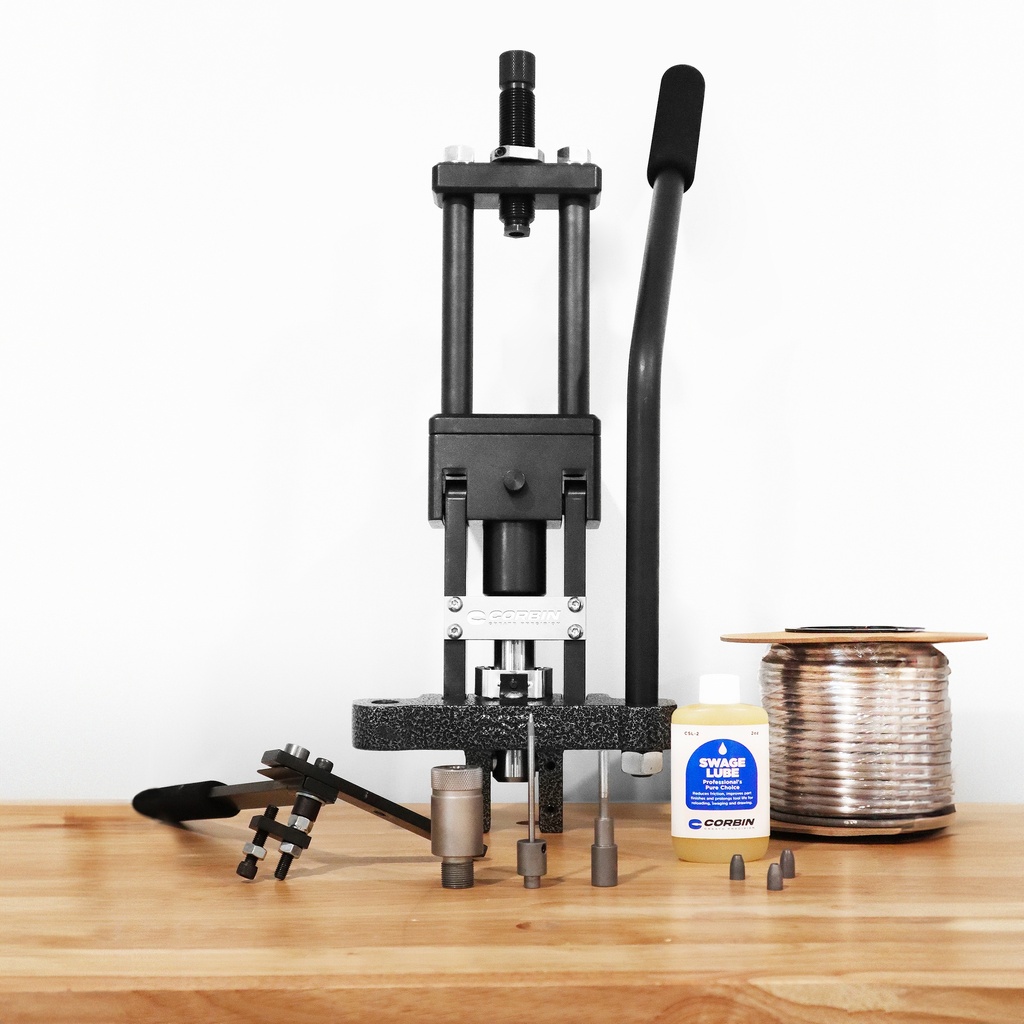
Jacketed rifle bullets are made on a true swaging press, not a reloading press. The die sits in the ram, the punch is in the head, and the finished part ejects on the down stroke.
- CSP-1 S-Press. The press most rifle bullet makers start with. It runs Corbin -S dies for most rifle calibers, up to .458 and 1.3 inches long.
- CSP-2 Mega-Mite. For bullets larger than .458 or longer than 1.3 inches. It runs -H dies, up to 1 inch in diameter. A .510, for example, needs the Mega-Mite or the Hydro-Press, not the S-Press.
- CHP-1 Hydro-Press. Our hydraulic press, for larger work (up to 1 inch and 2.5 inches long) and heavier production. It also uses -H dies, and weighs about 425 lb.
A larger press can still make the smaller calibers. The reverse isn't true. If you're still deciding, start with Choosing the Right Corbin Swaging Press.
→ Corbin S-Press · Mega-Mite Press · Hydro-Press
The Dies You'll Use
A standard jacketed rifle set is built from three dies, often sold together as an FJFB-3 3-die set (flat-base, open-tip or lead-tip bullets):
| Die | Catalog name | What it does |
|---|---|---|
| CSW-1 | Core Swage | Sets the core to a precise weight and diameter. Extra lead leaves through bleed holes. |
| CS-1 | Core Seater | Seats the core in the jacket and expands the jacket almost to finished size. |
| PF-1 | Point Form | Forms the ogive (the curved nose) and the finished diameter. |
To make a rebated boattail, you add the RBT (sometimes marked BT) dies. They form the stepped, tapered base before the bullet goes into the point form die. Corbin uses a rebated boattail, not a plain boattail, so the punches can keep a strong edge under swaging pressure.
Standard rifle jacketed die sets come in .224, .243, .264, .284, .308, .338 and .458, with a 6-S ogive and an open tip. You can order a flat base, a rebated boattail, or both, in -S (S-Press) or -H (Mega-Mite or Hydro-Press). Other diameters and ogives, including a longer ULD (ultra low drag) nose, are custom work. The dies in a set are fitted to each other, so don't mix a core seater from one set with a point former from another, even in the same caliber.
→ Standard rifle jacketed die sets · .224 · .243 · .264 · .284 · .308 · .338 · .458 · Core Swage Die
Step 1: Cut the Lead Core
Start with pure lead wire (or lead rod) in a diameter that drops freely into your core swage die. The wire should be at least .002 inch smaller than the die. For most .22 and 6mm jackets, .185 inch wire is the usual match. .30 caliber work often uses .247 inch wire.
Cut the wire with a Precision Core Cutter (PCC-1). It takes wire from .100 to .365 inch and has an adjustable stop for length. For .390 and .430 inch wire, use the Magnum Core Cutter. A core mould is another option if you want to cast cores from clean scrap lead.
How heavy to cut. Weigh a jacket, then subtract that weight from the finished bullet weight you want. That's your target core weight. Cut the cores 0.5 to 3 grains heavy. The core swage die can only remove lead, never add it, so every core needs a little extra to push through the bleed holes.
→ Lead Wire · Lead Rods · Precision Core Cutter · Magnum Core Cutter
Step 2: Swage the Core to Weight
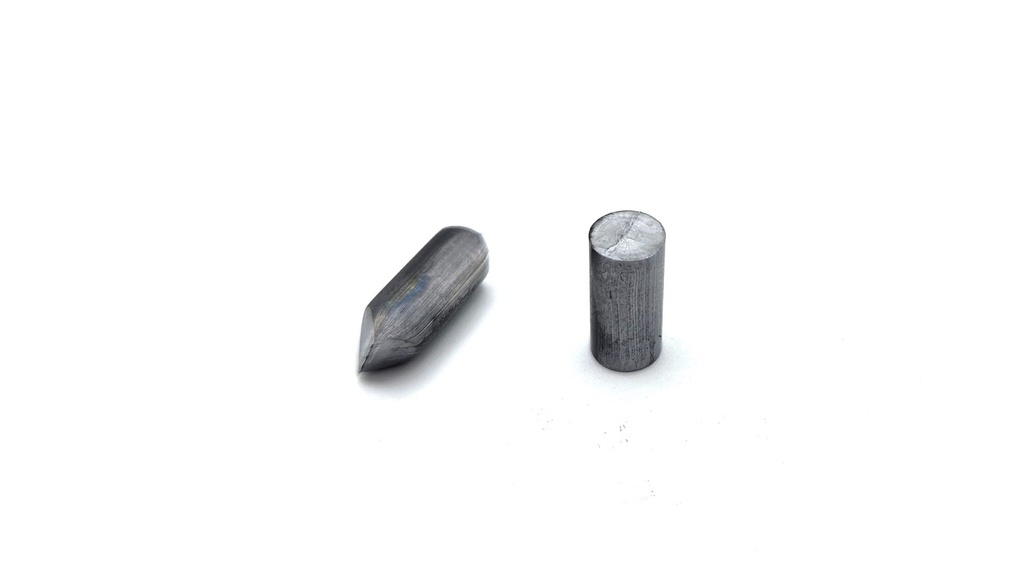
The CSW-1 core swage die is where the weight control happens. A lightly lubed core goes into the die, and the press squeezes it into a smooth cylinder of exact diameter and weight. Surplus lead leaves through the bleed holes as a thin wire, which you can save and use again. The CSW-1 can hold core weight to within about 0.5%. For even tighter weights, swage the core a second time, and pause about a second at the top of each stroke so the lead has time to flow.
If nothing comes out of the bleed holes, the core is too light or there isn't enough pressure yet. Use a slightly heavier core and work the pressure up until a steady wire of lead appears. Then wash the lube off the cores and dry them. Nothing but the core should go inside the jacket.
→ Core Swage Die and Punches · Corbin Swage Lube
Step 3: Seat the Core in the Jacket
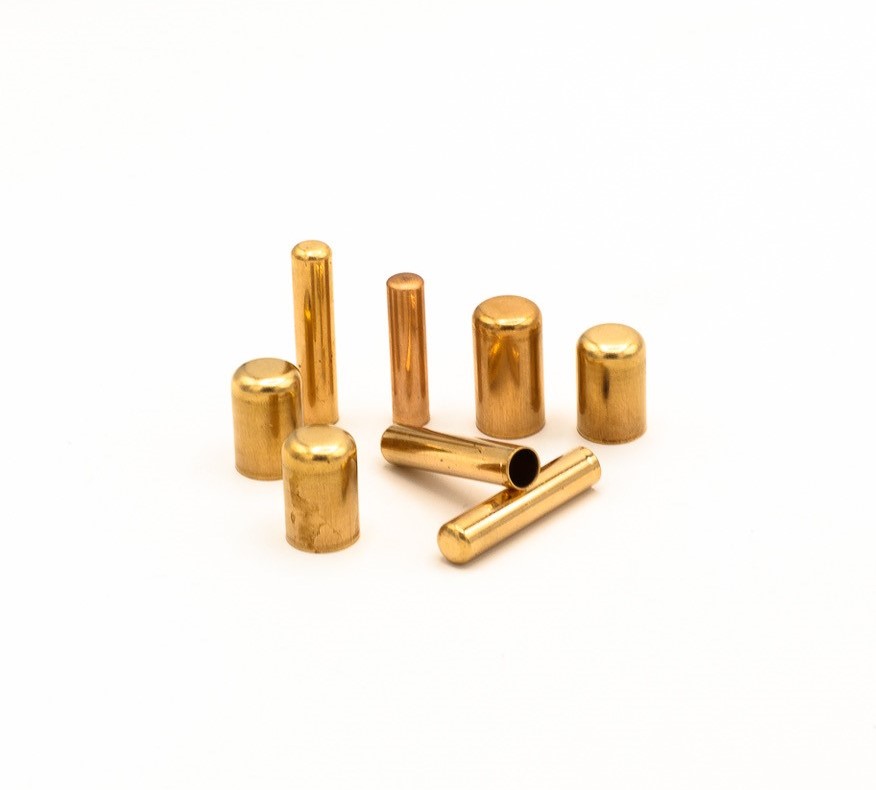
Drop each clean, dry core into a copper jacket by hand, then put a light coat of swage lube on the outside of the jacket only. Keep lube out of the inside.
The CS-1 core seating die presses the core into the jacket and expands the jacket out against the die wall. Most of the bullet's finished diameter is set here. Use a light touch once the jacket has filled the die. The seated part should come out about .0001 to .0002 inch under the final diameter, and it should drop into the point form die by hand. If it doesn't, it doesn't belong in that die.
This is also where you choose an open tip or a lead tip. A shorter core leaves an open tip after point forming. A longer core, up to the mouth of the jacket, will extrude a lead tip in the next step.
Corbin precision copper jackets are made for this work, in common rifle sizes. The .224 S-Press Swaging Kit also includes a rimfire jacket maker, so you can draw jackets from fired .22 LR cases.
Step 4: Form the Point
The PF-1 point form die puts the nose on the bullet. The standard rifle shape is a 6-S ogive, a pointed spitzer, finished as an open tip. Put the seated part in open end first, and close the tip in small steps until it comes down to the ejection pin. The die also brings the bullet to its finished diameter. That's your finished flat-base jacketed rifle bullet. Once the point is formed, don't re-swage it.
→ About Corbin Point Forming Dies
Step 5: Optionally Form a Rebated Boattail
If you want a boattail, it is formed with the RBT (BT) dies after the core is swaged and before you form the point, not as a last pass in the point form die. The RBT dies take the place of the usual flat-base core seating step, and the point form die then uses a matching boattail external punch.
A rebated boattail has a short taper and a small 90-degree step where the taper meets the shank. That step lets the punches survive swaging pressure, and it helps the bullet leave the muzzle cleanly. Compared with a flat base, it cuts drag, so the bullet holds its speed better and drifts less in the wind. You can order RBT dies with a new set, or add them later to a flat-base 3-die set.
Why Swaged Rifle Bullets Win
- Consistency. Every bullet is formed under high pressure in diamond-lapped dies, from a core brought to a set weight and a jacket of known size. Shot-to-shot variation stays small.
- Weight control. The CSW-1 trims each core to the weight you set. One die set can make a range of weights, not a single factory load.
- Uncommon calibers. If you shoot a caliber that is hard to buy, or you want a diameter that matches your barrel, we can make the dies. Standard rifle sets cover .224 through .458, and custom diameters are everyday work for us.
- Custom ogives. The standard 6-S is an excellent all-around rifle nose. If you want a longer ULD profile, a different tip, or a shape of your own, the point form die can be made to match.
Factory bullets are very good. A swaged bullet is the one you specified: the weight, the jacket, the ogive and the base your rifle actually wants.
Ready to Start?
If you already have a press, start with a die set in your caliber. If you're starting from scratch, a complete kit puts the press and the 3-die set on the bench together. The .224 S-Press Swaging Kit (KIT-224S) and the matching .243 kit (KIT-243S) are the usual place to begin, or you can build a setup in our firearm bullet swaging kit builder.
Not sure which diameter, base or ogive to order? Contact us or send a custom order. Tell us your caliber, the weight range you want, and what you're shooting, and we'll help you put the right set together.
Related Reading
- Choosing the Right Corbin Swaging Press
- How to Choose an Airgun Slug Die
- How to Swage Bullets
- Creating a Rebated Boattail
Shop: S-Press · Mega-Mite · Hydro-Press · Rifle Die Sets · Precision Jackets · Lead Wire · Contact Corbin
Corbin Manufacturing & Supply, Inc., White City, Oregon. Established 1975.
How Jacketed Rifle Bullets Are Swaged Step by Step