
It's one of the most common emails we get from PCP shooters: "I already have a good reloading press on my bench. Can I just buy a die and make my own slugs?"
It's a fair question. A reloading press is a solid tool, and nobody wants to buy a second press they don't need. The honest answer is no. The smooth-ogive slugs PCP shooters are after need a true swaging press, and we don't offer reloading press dies in airgun calibers.
Here's where the line falls, and why.
Pellets vs. Slugs: Two Different Shapes
Pellets are the classic airgun projectile. Most have a diabolo shape: a solid head, a narrow waist, and a thin, hollow skirt at the back. The skirt flares out to seal the bore and keep the pellet stable, a bit like a badminton shuttlecock. Pellets are usually stamped or formed in big batches. They're accurate and work great at short and medium range. But that waist and skirt create a lot of drag, so pellets shed speed quickly once they leave the barrel.
Slugs are solid, smooth-ogive projectiles. The straight shank blends smoothly into a curved nose, so a slug looks more like a small rifle bullet than a pellet. Solid-ogive and hollow-ogive styles are both available, with cup, dish, hollow, flat and rebated boattail bases.
The big difference is ballistic coefficient (BC). BC is a measure of how well a projectile cuts through the air. Slugs have a much higher BC than pellets, and in plain terms that means:
- Less drag. The slug holds its speed instead of slowing down quickly.
- A flatter trajectory. It drops less over distance, so you hold over less at longer ranges.
- More velocity and energy downrange. It still hits hard well past where a pellet runs out of steam.
Why Shooters Make the Switch to Slugs
- Consistency. A swaged slug is formed under high pressure in a diamond-lapped die from a uniform lead core cut to a set weight. Every slug comes out the same weight, diameter and shape, so it flies the same way shot after shot.
- Extended range. A higher BC and a flatter trajectory let you reach out farther with confidence.
- High winds. A slug holds its speed and spends less time in the air, so the wind pushes it around less. Less wind drift means fewer misses on gusty days.
- Clean, ethical kills. For hunters, a slug's retained energy downrange, plus good expansion from a hollow-point (hollow-ogive) design, means quicker, more humane kills on game and pests.
Slugs are the shape most PCP shooters ask us about, and they're what this post is about.
What a Reloading Press Can Do
Corbin makes the Pro-Swage die, along with other dies marked -R, for a sturdy slotted-ram reloading press with 7/8-14 threads. An RCBS Rock Chucker or Pacific MultiPower is the kind of press we mean. These dies are for firearm bullets: many pistol bullets with a semi-wadcutter shoulder, plus paper-patch bullets.
The Pro-Swage (PRO-1-R) die isn't offered in airgun calibers. So if your goal is airgun projectiles, a reloading press isn't the route. A Corbin swaging press is.
What a Reloading Press Can't Do
Smooth-ogive slugs can't be made in a reloading press. Corbin's slug dies (PF-1-SP for the S-Press, and PF-1-HP in the larger -H style) form the whole nose shape inside a diamond-lapped cavity. They rely on two things a reloading press isn't built to provide:
- A synchronized ejector. A swaging press pushes the finished slug out of the die on the down stroke. In a reloading press, the die sits in the press head, so you knock the projectile out by tapping a knock-out rod with a mallet.
- Weight adjustment as the slug forms. Corbin slug dies have bleed holes that trim surplus lead to your exact weight during the stroke. In a reloading press, the die is surrounded by the head threads, right where those bleed holes would need to be.
There is no reloading press version of a smooth-ogive slug die. That's a design limit, not a sales decision.
Leverage matters too. A reloading press needs roughly 4 inches of travel for its job. A swaging press can work in about 2, which roughly doubles the force you get from the same lever system.
One more thing we get asked: Corbin makes swaging dies, not reloading dies. If you want our presses to load cartridges too, the reloading adapter is an optional add-on, sold separately. So is the CSP-T primer tray.
When to Step Up: Airgunner or S-Press?
If you want smooth-ogive slugs tuned to your barrel, you'll want a swaging press. We build two that suit airgunners.
Airgunner™ Press
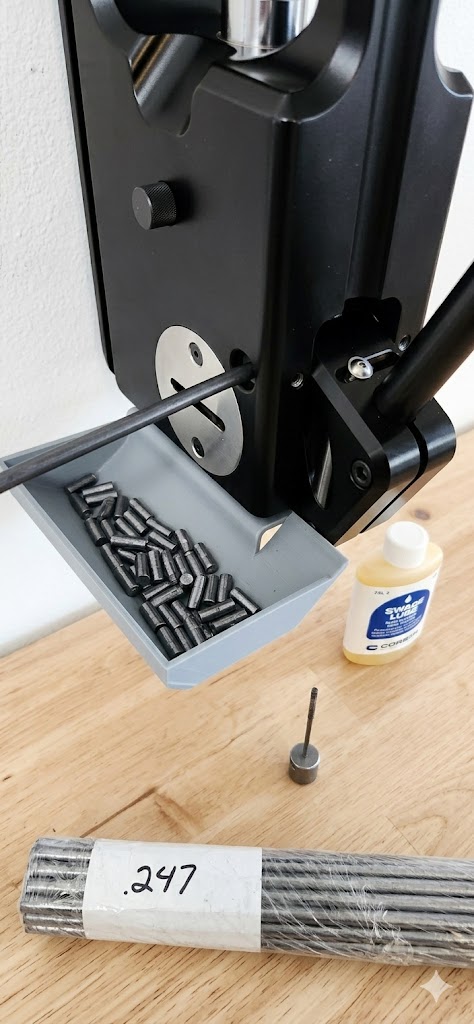
The Airgunner was built from the ground up for PCP shooters. It swages pure lead slugs from .177 to .358 using Corbin's S-style airgun dies. A patent-pending on-board core cutter lets you feed lead rod in from the side and cut each core in the first half of the stroke. The lightweight aluminum frame can hang on a wall with its keyhole mounts if you don't have permanent bench space.
Choose the Airgunner if airgun slugs are all you plan to make and your caliber is .358 or smaller.
CSP-1 S-Press
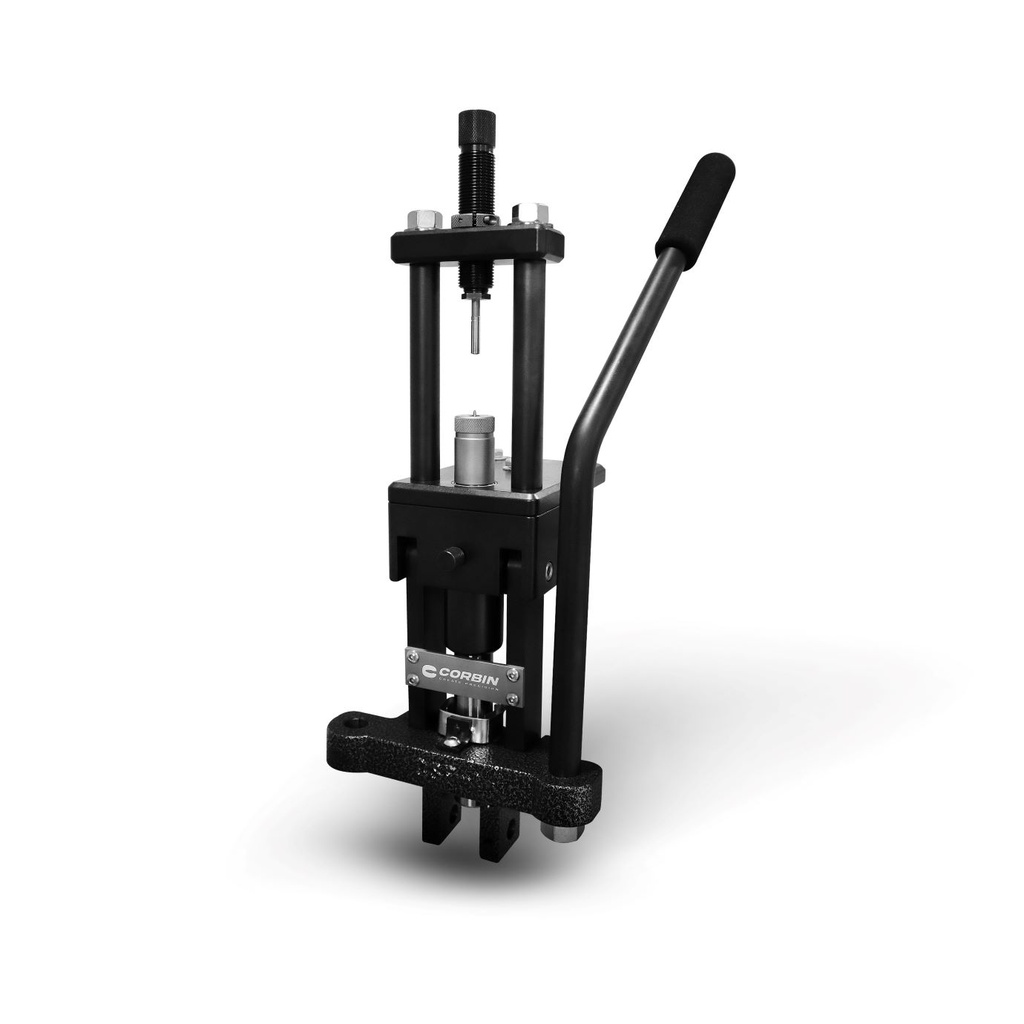
The S-Press is the all-rounder. It runs -S dies up to .458 caliber and 1.3 inches long, so it covers airgun slugs, handgun bullets and most rifle calibers. If you shoot .457 big bore, this is your press: the .457 airgun slug die runs only in the S-Press, not in the Airgunner.
Choose the S-Press if you shoot big bore, or you think you'll want to make firearm bullets or jackets someday.
Larger presses like the CSP-2 Mega-Mite and the CHP-1 Hydro-Press (about 425 lb, calibers up to 1 inch and lengths up to 2.5 inches) are built for larger calibers and production work. Most airgunners won't need that much press.
Getting Started with Slug Dies
Our airgun slug die sets are built around three choices: caliber, base and nose. Every set includes the die, a hollow point nose punch and a base punch, and fits both the S-Press and the Airgunner. Standard calibers are .177, .217, .218, .250, .300, .357 and .457. Extra base punches are available in dish, cup, flat and rebated boattail.
For ongoing supplies, you'll need pure lead rods, a little swage lube, and the die set for your caliber. There's no powder, no primer and no combustion anywhere in the process.
The Short Answer
- Your reloading press: it's great for loading cartridges, and with a Pro-Swage die it can swage some firearm bullets. Corbin doesn't offer reloading press dies in airgun calibers.
- Smooth-ogive PCP slugs: these need a swaging press, either the Airgunner (.177–.358) or the S-Press (up to .458, including .457 big bore).
- Not sure which fits your rifle? Send us your caliber, your barrel's land-to-land measurement if you have it, and the weight you're after. We'll tell you what will work.
Related Reading
- Choosing the Right Corbin Swaging Press
- Swaging Press or Reloading Press
- How to Make World-Class PCP Airgun Slugs at Home
- Corbin Pro-Swage Die
Shop: Airgunner Press · S-Press · Airgun Slug Die Sets · Lead Rods · Swage Lube · Contact Corbin
Corbin Manufacturing & Supply, Inc., White City, Oregon. Established 1975.
Making Airgun Slugs on a Reloading Press