Multi-part stacking bullets can be loaded into straight cases like the .357 Magnum and .45 Long Colt. Bullets that are composed of two or three independent sub-bullets, stacked together with a nose that fits into a hollow base on the next bullet ahead of it, can be loaded as a single projectile, and will separate slightly in flight. The drag on the base of the rearmost bullet will retard it, allowing the next bullet segment to retard and separate in turn. The result is a string of bullets, similar to a shot string from a shotgun shell, which impact in a tight pattern at 50 to 100 feet.

The benefits of multi-part bullets are that they lower the net penetration depth, while delivering the same total energy to the target. With three separate strikes, the bullets have a better chance of hitting a vital area in defense situations. With less penetration of each separate part, the risk of passing through the target and causing collateral damage is reduced. In night shooting situations, the ability to fire small groups with each pull of the trigger gives a nervous, frightened home defender greater odds of disabling an intruder quickly.
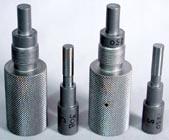
The bullets can be made with half-jackets (exposed lead noses) or entirely of lead. Or the rearmost bullet can be a Base Guard, gas check or half jacket. An easy way to make the bullets is to use the JSWC-2 two-die set. This set consists of a core swage die, to make accurate weight cores, and a core seating die, to form the base and nose and optionally seat the core into a jacket.
The normal JSWC-2 die set has a base punch (internal) and a nose punch (external) for the core seat die. The addition of two other punches, a hollow base internal punch and a matching nose punch. The special "stacking punches" added to the set allow production of matching truncated conical nose and base.


The base section is made by using the standard base (for example, a flat base) internal punch with a stacking "nose" or projection-forming punch. The middle section (of three-part bullets) is made by using the same stacking nose external punch but changing to a hollow cavity stacking internal punch. The nose section is formed by changing the external nose punch to a standard shape, but keeping the same hollow base punch in place.
After forming the individual sub-bullet sections (each weighing either half or a third of the weight of the total projectile assembly, which in turn is a normal safe weight for the caliber), clean them of all lubricant with a good solvent such as Corbin cleaning solvent. Then stack them together, insert the assembly into the core seat die with the normal base and nose punches installed, and lightly swage the bullet together for a perfectly fitted stack.
The bullet can be loaded into straight cases, but should not be used in bottleneck or tapered cases where there is any chance of the rearmost bullet section dropping free into the powder area. As long as all three (or two) segments are firmly seated into a case neck, or a straight case, the total weight of the separate segments can be used as if it were one projectile, and normal loads for that weight can be used.
The "socket and tang" design (hollow base that matches the angle and depth of a truncated conical nose) can be used with half-jacket style bullets. The front section can also be formed in a normal point forming die, using a socket-type hollow base punch, if the SWC shoulder isn't desired. Since the purpose of these bullets is primarily close range defense, the shoulder is usually a good feature, adding impact shock.
In autoloaders, the front section can even be a full metal jacket formed by reversing a normal 3/4-length jacket and seating a lead core into it with the hollow base stacking punch. Since the point forming die is slightly larger than the core seater, this would require a different base punch. Also, the point form die uses an external base punch, and the core seater normally uses an internal base punch.
| Designing Your Multi-Part Bullet Caution! Do not attempt to load multi-part bullets in a bottle-necked cartridge case! Only straight, parallel-ID cases should ever be used! A bulky powder is advised if possible to reduce the odds of the last bullet section moving back in the case and creating a gap between it and the next bullet ahead. When planning your multi-part bullet, first decide the maximum bullet weight that is safe for your load and gun. Then see if you can divide this by 2 or 3 and still have a reasonable amount of lead for shorter, individual projectiles. For example, suppose you are loading for a .38 Special or .357 Magnum. The typical bullet weight is around 158 grains, but you find a safe load for a 180 grain bullet and decide to try that weight (starting with a reduced load, of course). Dividing 180 by 3 gives you 60 grains. So you want to see if a 60 grain .357 diameter bullet can be made, and whether it will have enough of a nose to fit into the hollow base of the one in front of it. Experimenting with a large hollow base for the leading or "nose" bullet, you find that a 60 grain bullet is long enough to be stable in the barrel (at least one caliber in length). And so is the middle bullet. But making a solid base final third bullet uses so much of the lead volume that the last bullet appears to be too short. There are several options. You can make all three small bullets the same, with hollow bases and tang-like noses similar to an under-sized Keith nose. That makes them all 60 grains, all the same length, and they stack in any order. But you may find that the deep hollow base on the last bullet "flares" or expands from muzzle gas pressure as it exits the barrel, and therefore creates a "flyer" from your otherwise tight group shot. So another option is to make the third or trailing bullet with a solid base, or a more shallow cup base, and steal a few grains from the other two to increase the weight and thus the length for the last bullet. It can no longer fit in the middle or at the lead, of course, and the middle and leading bullet become slightly shorter. But this compromise may leave you with three stable bullets (each being just long enough to stay aligned in the barrel and in flight). There is no rule which requires you to make all three sections the same weight, or even with the same nose or base shape. You can use a different nose shape on the leading bullet, even a full wadcutter nose if you wish, so long as its base shape fits over the nose of the middle bullet. You can use any base on the trailing or final bullet since it doesn't have to fit over the nose of anything. (But it needs to work with the gas pressure present when the bullet emerges from the muzzle, and is no longer held to diameter by the barrel.) The only serious restraint on combined nose and base shape is for the middle bullet. It has to have a base cavity to fit over the last bullet's nose, and it has to have a nose shape that fits into the leading bullet's base. So the hollow base on the leading bullet should be designed first, keeping in mind that the nose of the middle bullet needs to be at least half a caliber long to provide some alignment. You CAN make two or four separate sections if the bullet weight doesn't work as well with three sections, or if the total weight allows division by four and still gives enough weight to the sections for a reasonable nose and shank length. Usually three bullet sections gives the optimum results. After making the separate sections, they can be assembled and then re-swaged to create a more uniform fit and close any gaps between sections. To do this, the nose punch for the lead bullet and the base punch for the trailing bullet are used in the same die. Loading should be done carefully so that the bullet does not separate during the process and is held securely by the cartridge case. The nose or leading bullet has to be secured by the grip of the case mouth, which can cause a heavy bullet to be seated more deeply than would be usual or safe with a normal load. The ID of the case also needs to be the same diameter for the length of the bullet seated area, so that the last bullet is not forced into a thicker taper (although a small amount of such compression could be tolerated). I've fired hundreds of rounds of multi-part bullets using straight walled cases such as a .44 Special, .44 Magnum, .38 Special, .357 Magnum, .41 Magnum, and .45 Colt. But in each instance the load was reduced from that suggested for a normal one-piece bullet, and the seating depth was checked carefully to make sure that the load data for the single bullet of the same weight did not result in a significantly different seating depth. Maximum loads were avoided. The resulting groups (or clusters, if you wish to use a different term for the patterns of three projectiles from one shot) generally were within what a person would expect for off-hand shooting at the same range if three separate shots had been fired. This only held for the shorter ranges, up to 15-20 feet away from the paper targets. Once the range was increased to 25-50 feet, the groups began to widen although they still kept within the 5 ring of an NRA 50-foot rapid-fire pistol target. But in the closer shots, patterns within 1.5-3 inches of each three-projectile cluster were common, which is decent accuracy for a person firing three separate shots at the same range, one-handed. More disperson could be created by NOT swaging the three slugs togehter for a snug assembly, or by placing small bullet ball (BB-1/8) between nose and base junctions, or by using the "wrong" nose or base match so that a close fit wasn't created. This made handling a little more difficult during loading, but was still possible to do. Using a Base Guard (BG) on the final bullet section helped keep the barrel free of leading. Spraying the bullet with a light coat of moly spray lube (which cures to a dry film coat) also helped keep the bore clean. Swaging short jacketed sections also reduced fouling but made it slightly more difficult to get a deep enough hollow base to mate with a reasonable nose shape. |
Start writing here...
Start Making Your Own Jacketed Bullets
Corbin Standard Rifle Jacketed Firearm Die Sets include everything you need to swage premium jacketed bullets from scratch — trusted by precision shooters for over 54 years.
Shop Firearm Die Sets →
About Corbin Multi-Part Stacking Bullets