The LSWC-1 lead semi-wadcutter die is used to make a semi-wadcutter style (shoulder between nose and shank) bullet. LSWC-1 dies can make lead, gas-check, or Base Guard bullets. The nose is formed in a cavity in one punch, and the base is formed against the end of the other punch. Three bleed holes around the circumference of the die allow surplus lead to be extruded from the core, to adjust the core weight.
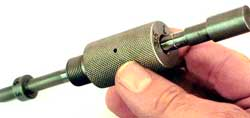
| LSWC dies may be supplied with a flat base, cup base, hollow base, dished base, or Base Guard base punch (usually the internal punch is the base punch). Custom punch shapes are also made to your order. The external punch, which pushes the lead core into the die, is normally the nose punch. The LSWC-1 die can be used to make these types of projectiles:
 To make a bevel base or a boattail angled base without a step, you need to use a die with the curve or angle machined into the die cavity. The LSWC-1 type of die uses a cavity machined into a punch, so the edge of the punch needs to be at least .015-inches thick to avoid being torn off under the pressure. This edge, by necessity, transfers a mirror image to the bullet. This is why any shape formed in a punch cavity, in the end of the punch, has to include a step or shoulder. 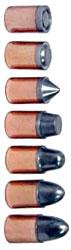 If you use a bullet jacket with the LSWC-1 type of die, a jacket short enough to let the lead core flow through the bleed holes should be used. Blocking the bleed holes means the lead must be pressurized enough to blow right through the jacket wall. This may be done with jackets which are less than .020 inches thick near the bleed holes, but the risk of over-pressuring and breaking the die is increased. You can easily see if a jacket will block the bleed holes by pushing the empty jacket down into the die when the ram is at the top of the stroke (use a dowel or small rod, with the punch holder removed from the press top to give you access to the die mouth). A thin wire or a pin that normally fits through the bleed holes can be tried, to see if it runs into the bullet jacket. If so, you would be taking a chance by using this length of jacket. If the pin or wire passes through bleed hole and into the empty space above the jacket, then it would be safe to use. If you use a bullet jacket with the LSWC-1 type of die, a jacket short enough to let the lead core flow through the bleed holes should be used. Blocking the bleed holes means the lead must be pressurized enough to blow right through the jacket wall. This may be done with jackets which are less than .020 inches thick near the bleed holes, but the risk of over-pressuring and breaking the die is increased. You can easily see if a jacket will block the bleed holes by pushing the empty jacket down into the die when the ram is at the top of the stroke (use a dowel or small rod, with the punch holder removed from the press top to give you access to the die mouth). A thin wire or a pin that normally fits through the bleed holes can be tried, to see if it runs into the bullet jacket. If so, you would be taking a chance by using this length of jacket. If the pin or wire passes through bleed hole and into the empty space above the jacket, then it would be safe to use.The nose punch can also be made with a conical projection, which forms a tapered hollow cavity. A double-ended hollow base wadcutter is made with two similar punches, one internal (which slides back and forth in the die to eject the bullet and to seal the bottom of the die during swagine). Various shapes of noses can be formed with only two punches, one standard hollow point and one any other shape, by fully forming the bullet with one punch, and then only partly pushing the second punch into it, in a second operation with the same die.  Because the lead is forced through tiny bleed holes in the side of the die, it is important not to use hard lead. The pressure goes up with the square of the lead hardness, so that going from a soft Bhn5 lead to a moderately hard Bhn10 lead can increase the die pressure by 4 times. Since the dies typically handle about 50,000 psi, and soft lead normally forms well and extrudes at 15,000 psi, it is obvious that even Bhn10 lead may require 60,000 psi or 10,000 psi more than the die could handle. Typical wheelweight lead ranges from Bhn10 to Bhn12. Pure lead is Bhn5. With the LSWC-1-H type of die, somewhat harder lead can be used. First send samples of the lead you plan to use and make sure the die-makers know you want to use it in the die. Then the bleed holes can be adjusted to allow extrusion with a reasonable pressure limit. Because the lead is forced through tiny bleed holes in the side of the die, it is important not to use hard lead. The pressure goes up with the square of the lead hardness, so that going from a soft Bhn5 lead to a moderately hard Bhn10 lead can increase the die pressure by 4 times. Since the dies typically handle about 50,000 psi, and soft lead normally forms well and extrudes at 15,000 psi, it is obvious that even Bhn10 lead may require 60,000 psi or 10,000 psi more than the die could handle. Typical wheelweight lead ranges from Bhn10 to Bhn12. Pure lead is Bhn5. With the LSWC-1-H type of die, somewhat harder lead can be used. First send samples of the lead you plan to use and make sure the die-makers know you want to use it in the die. Then the bleed holes can be adjusted to allow extrusion with a reasonable pressure limit.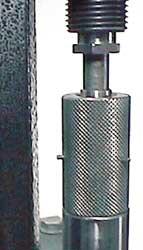 Swaging in the LSWC die is done by adjusting the punch holder so that the lead is pressurized as the press reaches the very top of its ram travel. This allows the use of the full press leverage, which makes the operation far easier than it otherwise would be. If more than one-hand pressure is needed, it means the lead is too hard for the die, the press is in the wrong stroke mode (reloading instead of swaging stroke), or the punch holder is simply not adjusted to the correct position. Even a half turn of the punch holder can mean the difference between standing on the handle with no movement, and one-hand easy operation! Sometimes this is a hard concept for a new bullet swager to grasp, but it is easy to prove to yourself by finding the right position, trying a few bullets, and then adjusting the punch holder closer to the ram and trying again. Swaging in the LSWC die is done by adjusting the punch holder so that the lead is pressurized as the press reaches the very top of its ram travel. This allows the use of the full press leverage, which makes the operation far easier than it otherwise would be. If more than one-hand pressure is needed, it means the lead is too hard for the die, the press is in the wrong stroke mode (reloading instead of swaging stroke), or the punch holder is simply not adjusted to the correct position. Even a half turn of the punch holder can mean the difference between standing on the handle with no movement, and one-hand easy operation! Sometimes this is a hard concept for a new bullet swager to grasp, but it is easy to prove to yourself by finding the right position, trying a few bullets, and then adjusting the punch holder closer to the ram and trying again. |
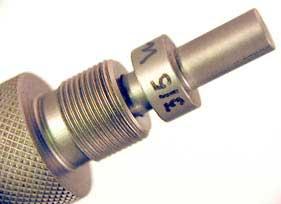
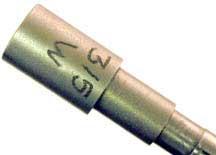
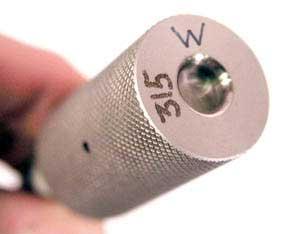
Punch and Die Markings
|


Start writing here...
About Corbin Lead Semi-Wadcutter Die